


When Everything You Built Comes Crashing Down
It’s 3:47 AM. I’m sitting in my childhood bedroom at my parents’ house, staring at my bank account. $247.32. That’s what’s left after draining my savings, maxing out two credit cards, and selling everything I owned to fund a dream that spectacularly imploded.
The shame is suffocating. I can hear my dad getting ready for work downstairs. He leaves at 5 AM every morning—has for 30 years. Meanwhile, his 32-year-old son is unemployed, broke, and sleeping in the room where he once had high school posters on the walls.
This is what starting over after failure actually looks like—and it’s nothing like the inspirational comeback stories you see on social media. While embracing failure for success is a powerful concept, the actual process of starting over after failure is far messier than any inspirational post suggests.
According to the U.S. Bureau of Labor Statistics, about 20% of small businesses fail in their first year, and 50% fail within five years. I became a statistic. However, what those numbers don’t tell you is what happens to the human being behind the failure—the actual process of starting over after failure.
Starting over after failure isn’t inspirational. It’s brutal, humiliating, and lonely. But if you’re reading this at 3 AM with your own version of $247.32, I want you to know three things nobody told me—truths that might actually help you survive this journey of starting over after failure.
Truth #1: Starting Over After Failure Begins with a Psychological War Zone
Let me be clear about something: starting over after failure doesn’t begin with motivation and determination. It begins with shame, regret, and a brain that replays every mistake on an endless loop.
The Mental Health Reality Nobody Discusses
For the first two weeks after my business collapsed, I couldn’t sleep past 4 AM. My mind would jolt me awake with a highlight reel of every bad decision, every ignored warning sign, every person I’d let down. Research from the National Institute of Mental Health shows that major life setbacks like starting over after failure can trigger symptoms similar to clinical depression, even in people with no prior mental health issues.
Here’s what I wish someone had told me:
Your brain is not your friend right now. After a major failure, your amygdala—the fear center of your brain—goes into overdrive. According to neuroscience research published in Nature Neuroscience, experiencing significant loss or failure can actually alter your brain chemistry temporarily. This isn’t weakness—your brain is doing exactly what evolution programmed it to do: punish you for a perceived survival threat.
The 3 AM thoughts are liars. Every thought that wakes you up in panic—”I’ll never recover,” “Everyone was right about me,” “I should just give up”—is a cognitive distortion. Dr. David Burns’ work on cognitive behavioral therapy identifies these as “all-or-nothing thinking” and “catastrophizing.” While knowing this doesn’t make them stop, it helps you recognize them as symptoms, not truths.
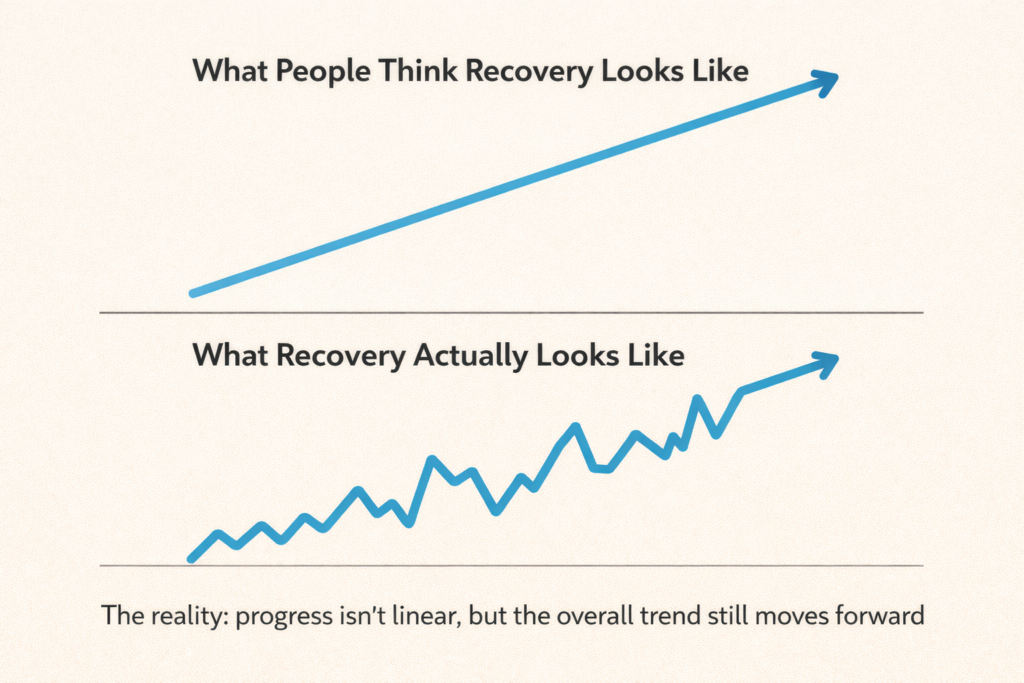
You will have setbacks within your setback. Three weeks into living with my parents, I had what I can only describe as a breakdown. At the grocery store, I couldn’t afford the cereal I wanted and had to put it back. Something about that moment shattered me. I sat in my car and cried for 20 minutes. These moments will happen, but they don’t mean you’re not making progress. moment shattered me. I sat in my car and cried for 20 minutes. These moments will happen. They don’t mean you’re not making progress.
The Survival Protocol for Starting Over After Failure
I’m not going to tell you to “practice gratitude” or “stay positive.” That toxic positivity bullshit nearly broke me. Instead, here’s what actually worked when starting over after failure:
The 5-5-5 Rule: When panic hits (and it will), identify five things you can see, five things you can hear, and five things you can physically feel. This grounding technique, recommended by trauma therapists, forces your brain out of catastrophic thinking and back into the present moment.
The Daily Minimum: Creating a list of three non-negotiable actions saved me: shower, eat two meals, and leave the house for 15 minutes. That’s it. On my worst days, completing just these three things was a victory. The American Psychological Association confirms that maintaining basic routines during crisis helps prevent the downward spiral into depression.
The Shame Conversation: Telling three people the complete truth—not the sanitized version, but the ugly details of how badly I’d failed and how scared I was—changed everything. One of them (my college roommate) said, “Welcome to the club. I went bankrupt at 28.” I had no idea. Shame thrives in silence, but research shows that vulnerability and disclosure are critical for emotional processing and recovery.
Truth #2: Starting Over After Failure Requires Killing Your Old Identity
Here’s something nobody warned me about: the hardest part of starting over after failure isn’t rebuilding what you lost. It’s accepting that the person you were is dead, and you have to become someone new.
The Identity Crisis of Starting Over After Failure
For three years, I was “the founder.” I went to startup events, networking mixers, and pitch competitions. My Instagram bio said “Entrepreneur | Building the Future.” My sense of self was completely wrapped up in this identity.
When it collapsed, I didn’t just lose a business. I lost my answer to “What do you do?” I lost my social circle (most of my friends were from the startup world). I lost my sense of purpose and direction. This is one of the hardest parts of starting over after failure that nobody warns you about.
According to research in organizational psychology, people who derive their primary identity from their work or career experience significantly higher psychological distress when that identity is threatened or lost. This isn’t vanity or ego—it’s a fundamental crisis of self-concept.
The Brutal Reality of Social Collapse
Within six weeks of my business failing, my phone stopped ringing. The “mentors” who praised my hustle ghosted me. The networking contacts who wanted to “grab coffee sometime” were suddenly unavailable. My Instagram engagement dropped by 80%.
This social abandonment was almost more painful than the business failure itself. I learned a hard truth: when you’re winning, everyone wants to be associated with you. When you’re losing, you become invisible.
A Harvard study on social networks found that people who experience major setbacks often lose 30-50% of their social connections within the first year. This isn’t because people are necessarily malicious—it’s because our society is deeply uncomfortable with failure. People don’t know what to say, so they say nothing.
The Counterintuitive Path Forward When Starting Over After Failure
Here’s what actually helped me build a new identity after starting over after failure:
Stop trying to rebuild your old life. This is crucial when starting over after failure. Your brain wants to return to what was familiar, but that path is blocked. The business model that failed isn’t coming back. The market conditions that existed are gone. The person you were had blind spots and flaws that led to this moment. Trying to resurrect that version of yourself is a recipe for repeated failure.
Embrace the reset as data collection. I started viewing my failure as the most expensive education I’d ever received. Every mistake was a lesson about what doesn’t work. Research from the Journal of Business Venturing shows that entrepreneurs who’ve experienced business failure are actually more likely to succeed in subsequent ventures—but only if they actively extract and apply lessons from the failure.
Build identity through action, not achievement. Instead of defining myself by what I’d accomplished (or hadn’t), I started identifying as someone who takes action despite fear. I wasn’t “a successful entrepreneur”—I was “someone who learns from mistakes and keeps going.” This subtle shift was psychologically transformative.
Find one person who’s been there. I joined a support group for entrepreneurs who’d experienced business failures. Hearing other people’s stories—people who’d lost more than me and rebuilt successfully—gave me hope in a way that motivational quotes never could. Organizations like Entrepreneurs’ Organization have resources specifically for members dealing with business setbacks.

Truth #3: The Financial Reality of Starting Over After Failure Is Unforgiving (But Not Impossible)
Let’s talk about the part everyone avoids: the brutal financial reality of starting over after failure. Because all the psychological growth in the world doesn’t pay rent.
The Real Numbers Nobody Shows You When Starting Over After Failure
After my business failed, my financial situation was devastating:
- Debt: $47,000 across credit cards and a business loan
- Income: $0
- Savings: Gone
- Assets: Sold everything of value
- Credit score: Dropped 180 points
Here’s what starting over after failure actually looks like financially, according to my personal experience and data from financial recovery:
The First Year: Month by Month Progress
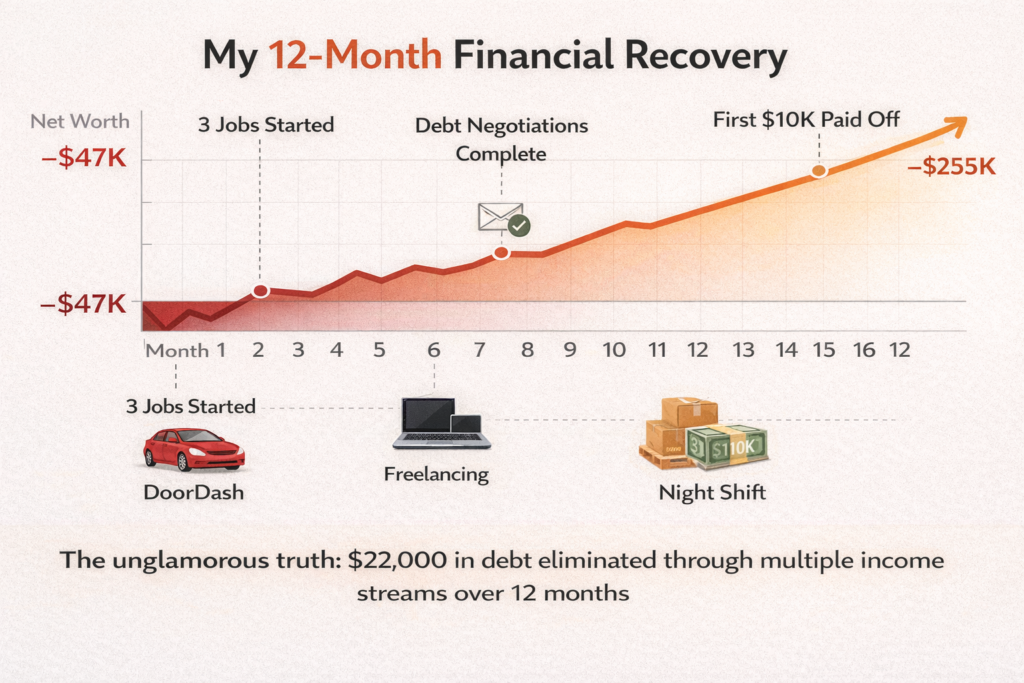
Month 1-3: I worked three part-time jobs simultaneously. Door Dash driver (mornings), freelance writing (afternoons), and night shift warehouse work (weekends). I made roughly $2,800/month gross. After minimum debt payments, I had $600 for everything else. This wasn’t living—it was surviving. This is the brutal reality of starting over after failure.
Month 4-6: I got a full-time job in sales I was overqualified for. It paid $45,000/year—less than half what I was making as a founder. The ego hit was brutal, but it provided stability. I kept one side hustle (freelance writing) and added another $800/month.
Month 7-12: I started applying lessons from my failed business to my freelance work. Slowly, my writing income grew to $1,500/month. I paid off $8,000 in debt using the avalanche method (highest interest first, recommended by financial experts like Dave Ramsey).
The Actual Timeline for Financial Recovery
The financial recovery timeline that nobody tells you:
According to research from the Federal Reserve, people who experience major financial setbacks take an average of 3-5 years to return to their pre-crisis financial position. This assumes they have stable employment and no additional setbacks.
For entrepreneurs specifically, the timeline can be longer because starting over often means taking lower-paying work initially while rebuilding skills and reputation. The Kauffman Foundation, which studies entrepreneurship, found that failed entrepreneurs who returned to traditional employment took an average of 18 months to reach salary parity with their peer group.
Here’s my actual 12-month financial progression:
- Month 1: Net worth: -$47,000
- Month 3: Net worth: -$44,500
- Month 6: Net worth: -$39,000
- Month 9: Net worth: -$32,000
- Month 12: Net worth: -$25,000
Not sexy. Not Instagram-worthy. But real progress measured in thousands of dollars of debt eliminated through relentless, unglamorous work.
The Practical Money Moves That Worked
The Budget of Shame: I tracked every single expense in an app. Everything. The $2.50 coffee, the $7 lunch, the $15 streaming subscription. Seeing where money went was humiliating but necessary. I cut expenses by 60% in three months.
The Negotiation Nobody Talks About: I called every creditor and negotiated new payment plans. Most worked with me. My student loan servicer offered temporary forbearance. My credit card company lowered my interest rate from 22% to 15%. I was terrified to make these calls, but they saved me roughly $400/month.
The Side Hustle Stack: I optimized my time ruthlessly. Door Dash during breakfast rush (7-10 AM, $60-80). Full-time job (10 AM-6 PM). Freelance writing (7-10 PM, $40-60). One night shift weekly (10 PM-6 AM Saturday, $180). This schedule was unsustainable long-term, but it gave me the cash flow to avoid bankruptcy.
The Emergency Fund Paradox: Even while drowning in debt, I saved $50/month in a separate account I couldn’t easily access. Financial experts from Suze Orman to the Consumer Financial Protection Bureau emphasize this. When the next emergency hit (car repair, $800), I had some buffer instead of adding more debt.
The Unspoken Gift of Rock Bottom When Starting Over After Failure
Here’s something strange: eighteen months into this nightmare of starting over after failure, I realized I was more resilient, more authentic, and more skilled than I’d ever been as a “successful” entrepreneur.
What Starting Over After Failure Taught Me That Success Never Could
Here’s something strange: eighteen months into this nightmare of starting over after failure, I realized I was more resilient, more authentic, and more skilled than I’d ever been as a “successful” entrepreneur.
What Starting Over After Failure Taught Me That Success Never Could
I learned what I’m actually made of. When everything external is stripped away—money, status, reputation—you discover your core. Turns out, I’m tougher than I thought. Not in a motivational poster way, but in a “I can work three jobs, pay down debt, and still show up for my life” way.
My real people revealed themselves. Out of roughly 200 “professional contacts,” only five checked on me regularly during the worst of it. My college roommate, my sister, two guys from my gym, and a former colleague who’d also failed spectacularly. Those five are now my inner circle. Quality over quantity in relationships is real.
Skills I’d never prioritized became essential. As a founder, I was always “too busy” for systematic learning. Starting over forced me to actually develop skills instead of just managing people who had them. My copywriting, sales ability, and financial management are exponentially better now because I had to use them to survive.
The biggest lesson: my worth isn’t my work. This is the big one. When I was successful, I genuinely believed my value as a person was tied to my professional achievements. Failure separated those things. Facing the question “If I never achieve anything impressive again, am I still worthy of love, respect, and belonging?” led to a profound realization: yes. That insight was worth the $47,000 tuition.
Research from Dr. Brené Brown’s work on shame and vulnerability confirms that people who experience major setbacks and process them authentically often report higher levels of self-compassion, stronger relationships, and more realistic self-assessment than those who haven’t faced significant failure.
If You’re Starting Over After Failure Right Now
If you’re reading this from your own version of 3 AM desperation, here’s what I want you to know about starting over after failure:
What to Expect on Your Journey of Starting Over After Failure
This will take longer than you want it to. Financial recovery, psychological healing, and identity reconstruction don’t happen in 90 days or even six months. Set realistic expectations when starting over after failure. You’re looking at 2-3 years of hard, unglamorous work. Accept this timeline now, and you’ll avoid the secondary trauma of thinking you’re “behind” when you’re actually progressing normally.
You will have setbacks within your comeback. Two steps forward, one step back isn’t a cliché—it’s the actual pattern. I paid off $5,000 in debt, then my laptop died and I had to add $1,200 to my credit card. This is normal. Don’t let the backward steps convince you the forward momentum isn’t real.
The shame will decrease, but slowly. For the first six months, I couldn’t tell people what I actually did for work without feeling intense embarrassment. By month 12, I could say “I’m doing sales and freelance writing while I figure out next steps” without wanting to crawl out of my skin. By month 18, I felt no shame at all—just recognition that I was on a different path than planned.
You are not your failure. This sounds like a platitude, but it’s literally true. You are a person who experienced failure, which is different from being a failure. Research in cognitive psychology shows that people who can separate their self-worth from their outcomes demonstrate better recovery and higher subsequent performance.
There is life after this. I know you can’t see it right now. When you’re at $247.32, broke, scared, and ashamed, the idea of future success feels impossible. But here’s my current reality 18 months later: I’m debt-free except for $12,000 remaining, I have $8,000 in savings, and I’m building something new (slower this time, smarter this time). More importantly, I like myself more than I did when I was “successful.” That’s the power of truly embracing failure for success—it transforms not just what you do, but who you are.

The Practical Next Steps (Because Inspiration Without Action Is Useless)
If you’re starting over, here’s your 30-day action plan:
1: Stabilize
- Get basic income flowing: Take whatever work you can get immediately. Pride is expensive.
- Create your minimum daily routine: Shower, eat, move your body. Non-negotiable.
- Tell three people the truth: Break the shame spiral with disclosure.
- Track every expense: Use an app like Mint or YNAB to see where money goes.
2: Assess
- List your debts from highest to lowest interest rate: This is your payment priority.
- Inventory your skills: What can you do that people will pay for immediately?
- Contact creditors: Negotiate payment plans before they go to collections.
- Find your community: Support group, forum, or one person who’s been where you are.
3: Plan
- Create a 90-day financial goal: Realistic, specific, measurable. Example: “Pay off $2,000 of highest-interest debt.”
- Identify income streams: What combination of work gets you to your minimum monthly needs?
- Schedule skill development: One hour daily to learn something that increases your earning potential.
- Set boundaries with shame: Notice when you’re ruminating, redirect with the 5-5-5 rule.
4: Execute
- Apply the debt repayment strategy: Start with the avalanche method (highest interest first).
- Launch at least one income experiment: Test a side hustle idea with minimal investment.
- Check in with your support system: Weekly conversation with someone who understands.
- Measure progress: Track one metric (debt paid, money saved, income increased) weekly.
Resources That Actually Helped Me
Books:
- The Obstacle Is the Way by Ryan Holiday (Stoic philosophy for difficult times)
- Atomic Habits by James Clear (Building systems when motivation fails)
- Your Money or Your Life by Vicki Robin (Financial recovery framework)
Podcasts:
- How I Built This by Guy Raz (Entrepreneurs discuss their failures)
- The Ramsey Show (Practical debt elimination strategies)
- On Being with Krista Tippett (Meaning-making through difficulty)
Organizations:
- National Suicide Prevention Lifeline: 988 (If thoughts get dark)
- Financial Counseling Association of America: Free credit counseling
- SCORE: Free mentoring for entrepreneurs, including those recovering from failure
Online Communities:
- r/Entrepreneur on Reddit (Failure stories and real talk)
- Indie Hackers (Transparent discussions about business struggles)
- Local entrepreneur meetups (Find via Meetup.com or Eventbrite)
The Truth About Starting Over After Failure
Starting over after failure is not the hero’s journey. It’s not a comeback story. At least not while you’re in it.
Starting over after failure is working three jobs you’re overqualified for. Avoiding friends because you can’t afford to split the check. Your dad offering to pay for groceries—and the wave of shame that hits when you say yes. Explaining to a date why you’re living with your parents at 32. 3 AM panic attacks that make you question everything.
But here’s what starting over after failure also is: discovering that you’re stronger than you knew. Learning that your worth isn’t your net worth. Finding out who actually cares about you versus who cared about your success. Building skills through necessity that you’d never have developed through choice. Creating a foundation based on reality instead of delusion.
According to long-term research on resilience from the University of Pennsylvania, people who face significant adversity and develop coping mechanisms often demonstrate what researchers call “post-traumatic growth”—they don’t just return to baseline, they actually develop greater psychological strength, deeper relationships, and more realistic self-assessment than they had before the trauma.
Eighteen months ago, I was at $247.32, sleeping in my childhood bedroom, convinced my life was over. Today, I’m not “successful” by society’s standards. I don’t have a thriving business or a six-figure income or an inspirational TED talk.
What I have is this: $8,000 in savings, $12,000 left in debt (down from $47,000), three jobs I don’t hate, a small group of people who saw me at my worst and stayed, and a growing sense that I’m building something real this time. The journey of starting over after failure has been the hardest thing I’ve ever done—and the most transformative.
More importantly, I have the knowledge that I survived the worst period of my life. When the next hard thing comes—and it will—I won’t question whether I can handle it. I’ll know I can because I already did.
That’s the truth about starting over after failure that nobody tells you: it doesn’t make you invincible, but it does make you certain of your resilience. And that certainty is worth more than the success you lost.
Your Turn: Share Your Story of Starting Over After Failure
If you’re starting over after failure right now, I want to hear from you. Not your success story—your current reality.
Leave a comment below:
- Where are you in the starting over process?
- What’s the hardest part right now?
- What’s one small win you’ve had recently?
Subscribe to get weekly posts on the messy reality of rebuilding after failure. No toxic positivity. No overnight success stories. Just real talk about real recovery.
Share this post with someone who needs to know they’re not alone in their 3 AM thoughts.
Remember: the fact that you’re reading this at whatever time you found it means you’re still fighting. That matters more than you know.
Keep going.
Related Posts You’ll Love:
- Embracing Failure for Success: The Story Behind “The Loser” – Why I named this blog “The Loser” and the manifesto for turning defeats into data
- [Coming Soon] From Founder to Freelancer: The Identity Crisis Nobody Warns You About
- [Coming Soon] The Actual Cost of Business Failure: A 12-Month Financial Breakdown
- [Coming Soon] 5 Skills Nobody Teaches You Until You’re Desperate

Leave a Reply